D365 : Sales line copy/paste at <250ms/line – Vibe coding

I see several are struggling with doing copy/paste of sales order lines, especially if the orders are large and there are complex logics for SCM and pricing. Based on how you set up D365, you will see examples where pasting a sales line can take from 1.5s and also beoynd 6s per line. And there are also much worse examples.

I have really gone into all code and SQL statements happening, and there are a LOT happening.

So I asked my-self, can I with AI do better ? Should I try a few minutes with “Vibe coding” ?

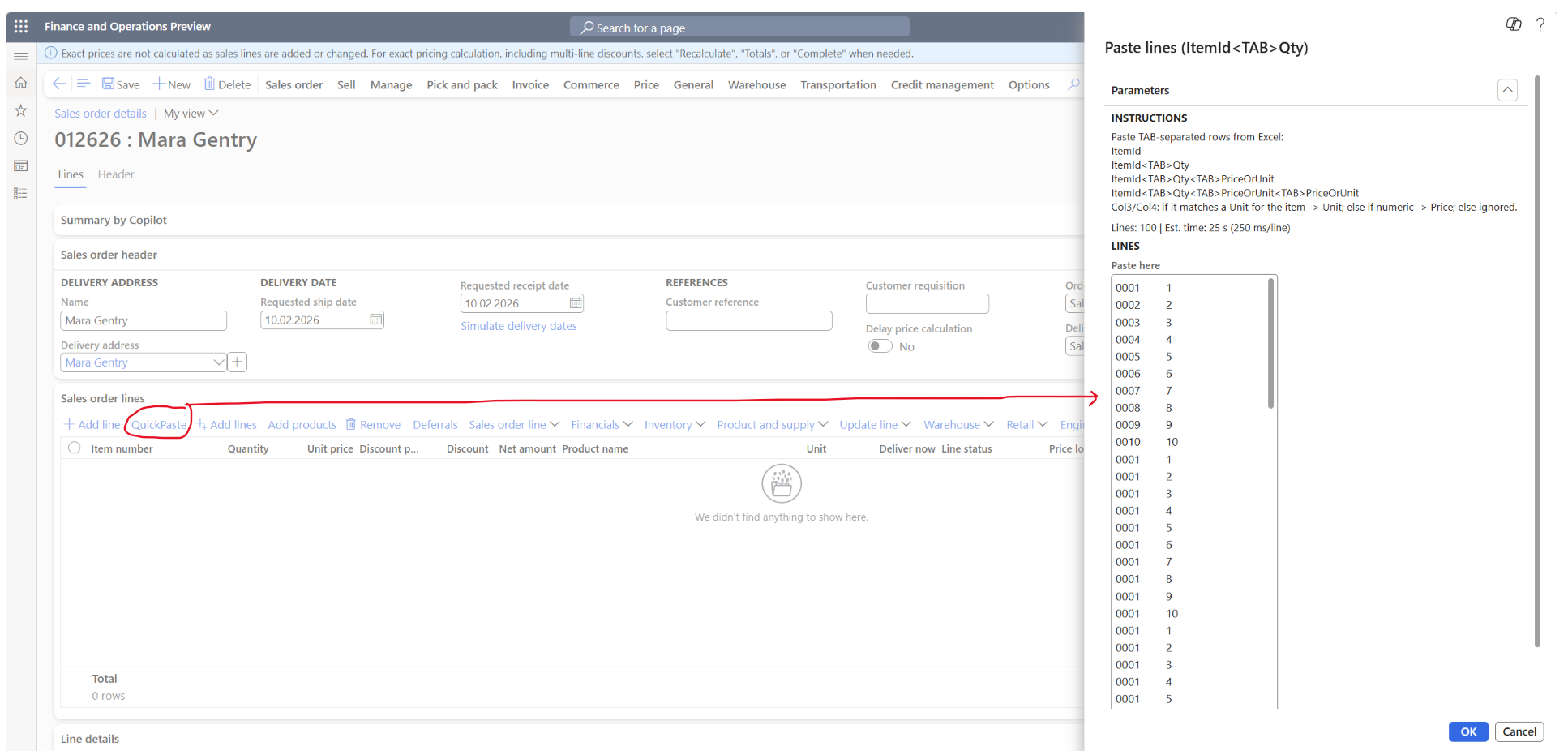
My idea is to not paste into the grid, but rather paste into a text field, and then have a single class create the sales lines within the same TTS.

So I asked ChatGPT for it. After a few iterations it actually created the class that does exactly that. I just needed to add a menu item, and then add it to the sales lines form.

Here are the solution it created:
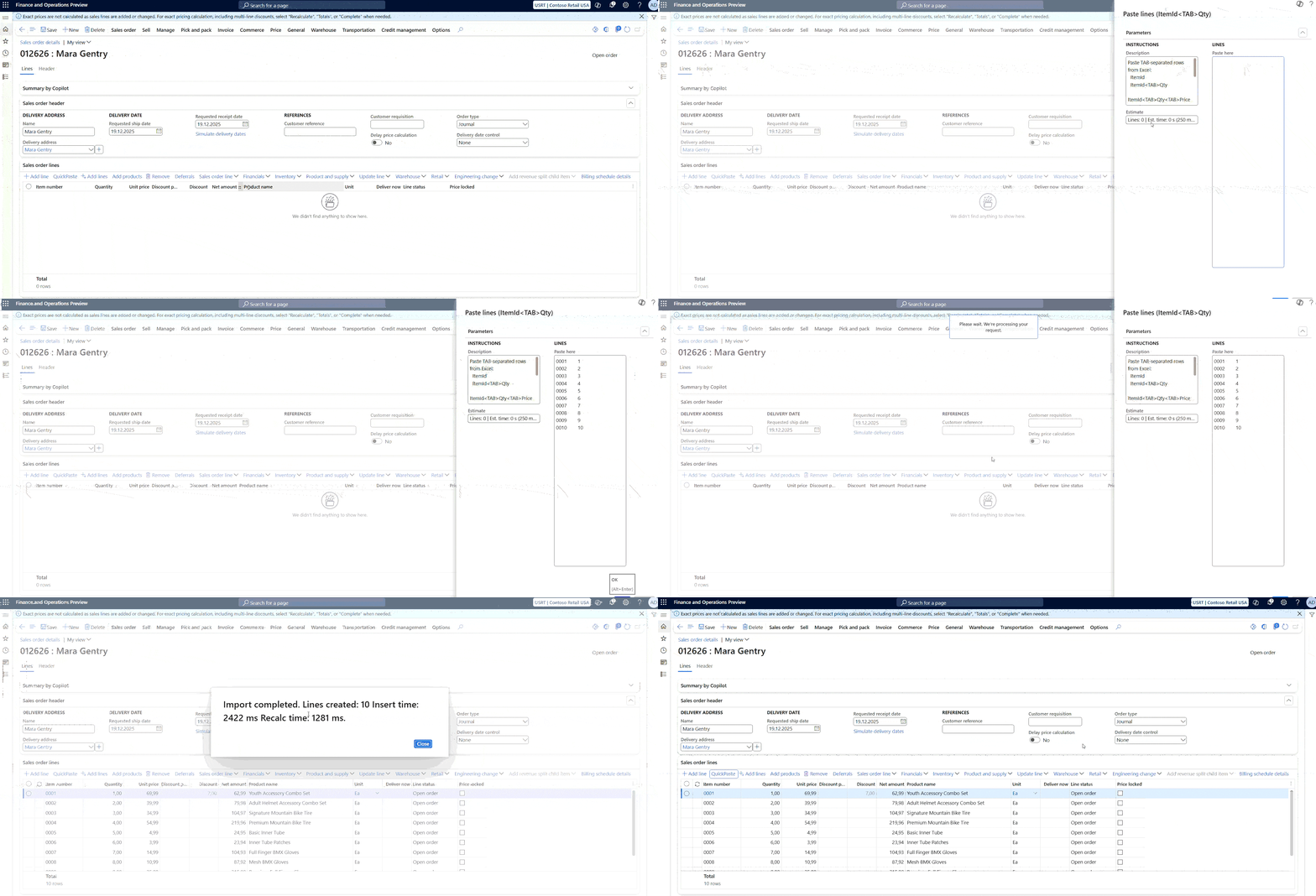
We have a “QuickPaste” button on the sales order form, that brings up a dialog, where we can paste the item[tab]Qty. I also made him create an estimator to show how long it would take to create the 100 lines.

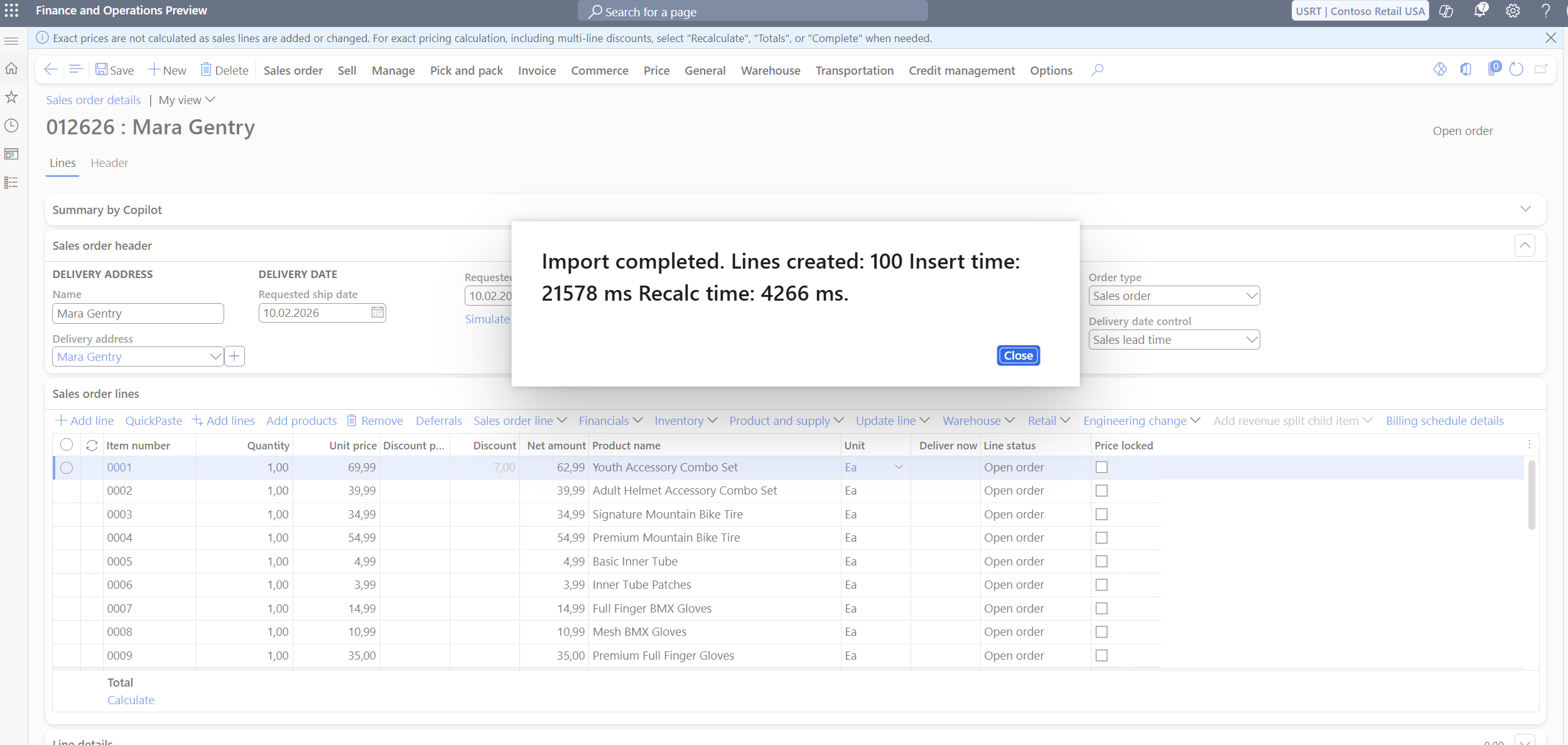
Next, when clicking “OK”, and 25s later, I have a sales order with 100 lines:

Nice 🙂 245ms in a UDE sandbox is not bad. In a production system, I hope to see it even further down towards 100ms per sales line.

As this is “Vibe coding” the code is not production ready, and should be considered as a alfa preview. There are tonns of possibilities to improve this, and is someone created a Github project on it, we could create something for those that hate waiting for copy/paste.

Here are the code for this demo:

/// Action menu item: Class = SalesOrderQuickPasteLines
/// Paste rows: TAB-separated (Excel). Extra columns ignored.
///
/// Formats:
///  1) ItemId
///  2) ItemIdQty
///  3) ItemIdQty{PriceOrUnit}
///  4) ItemIdQty{PriceOrUnit}{PriceOrUnit}
///
/// Rules:
///  - Qty defaults to 1 if omitted/invalid.
///  - Price vs Unit ambiguity (col3/col4):
///      * If value matches a Unit for the item => treat as SalesUnit
///      * Else if numeric => treat as Price
///      * Else ignore
///  - If both are supplied across col3/col4, both are applied.
///  - >4 columns ignored.
///
/// Behavior:
///  - Insert in ONE TTS; abort on first failing row (ttsAbort + row/why).
///  - st.GUPDelayPricingCalculation=Yes during insert TTS; restored before commit.
///  - sl.SkipCreateMarkup=Yes on inserted lines; cleared OUTSIDE TTS before retail recalc.
///  - Retail recalc OUTSIDE TTS: MCRSalesTableController::recalculateRetailPricesDiscounts(st)
///  - Refresh SalesLine grid via caller datasource executeQuery.
///
/// UI (guideline-aligned):
///  - Single-column dialog layout (no side-by-side fields)
///  - Short instruction block at top (no scroll in help)
///  - Estimate directly under instructions (always visible)
///  - Large multiline paste box below
class SalesOrderQuickPasteLines extends RunBase
{
    #define.ProgressEvery(20)
    #define.MaxErr(4000)
    #define.MsPerLine(250)
    #define.AggregateSameItemId(false)

    SalesId salesId;
    FormRun callerFr;
    str     pasteText;

    DialogGroup gIntro, gLines;
    DialogField dfHelp, dfEst, dfLines;
    FormStringControl cLines, cEst;

    public static void main(Args _a)
    {
        SalesTable st = _a ? _a.record() : null;
        if (!st || st.TableId != tableNum(SalesTable))
            throw error("Run from SalesTable.");

        SalesOrderQuickPasteLines o = new SalesOrderQuickPasteLines();
        o.parmSalesId(st.SalesId);
        o.parmCaller(_a ? _a.caller() as FormRun : null);

        if (o.prompt())
            o.runOperation();
    }

    public boolean canRunInNewSession()
    {
        return false;
    }

    public SalesId parmSalesId(SalesId _v = salesId)
    {
        salesId = _v; return salesId;
    }

    public FormRun parmCaller(FormRun _v = callerFr)
    {
        callerFr = _v; return callerFr;
    }

    // ---------------- Dialog ----------------
    public Object dialog()
    {
        Dialog d = super();
        d.caption("Paste lines (ItemIdQty)");

        // Force single-column layout using separate groups + 1 column
        gIntro = d.addGroup("Instructions");
        gIntro.columns(1);

        dfHelp = d.addField(extendedTypeStr(Description), " ");
        dfHelp.allowEdit(false);
        dfHelp.displayLength(200);
        dfHelp.displayHeight(6);
        dfHelp.value(
            "Paste TAB-separated rows from Excel:\n"
          + "  ItemId\n"
          + "  ItemIdQty\n"
          + "  ItemIdQtyPriceOrUnit\n"
          + "  ItemIdQtyPriceOrUnitPriceOrUnit\n"
          + "Col3/Col4: if it matches a Unit for the item -> Unit; else if numeric -> Price; else ignored.");

        dfEst = d.addField(extendedTypeStr(Description), "Estimate");
        dfEst.allowEdit(false);
        dfEst.displayLength(200);
        dfEst.value("Lines: 0 | Est. time: 0 s (250 ms/line)");

        gLines = d.addGroup("Lines");
        gLines.columns(1);

        // FreeText renders better as multiline paste box than Notes in many environments
        dfLines = d.addField(extendedTypeStr(FreeText), "Paste here");
        dfLines.value("");
        dfLines.displayLength(200);
        dfLines.displayHeight(28);

        return d;
    }

    public void dialogPostRun(DialogRunbase _d)
    {
        super(_d);

        cLines = dfLines.control() as FormStringControl;
        cEst   = dfEst.control()   as FormStringControl;

        if (cLines)
        {
            cLines.registerOverrideMethod(
                methodStr(FormStringControl, modified),
                methodStr(SalesOrderQuickPasteLines, lines_modified),
                this);
        }

        this.updateEstimate(cLines ? cLines.text() : "");
    }

    public boolean getFromDialog()
    {
        boolean ok = super();
        pasteText = strLRTrim(dfLines.value());
        return ok;
    }

    // ---------------- Execution ----------------
    public void run()
    {
        if (!pasteText) return;

        // parse returns [lineNo,itemId,qty,c3,c4]
        List rows = this.parse(pasteText);
        int inputCount = rows.elements();
        if (!inputCount) throw error("No valid rows. Expected at least ItemId per line.");

        int64 t0 = WinAPIServer::getTickCount();
        int created = this.insertLinesInOneTts(rows, inputCount);
        int64 insertMs = WinAPIServer::getTickCount() - t0;

        int64 t1 = WinAPIServer::getTickCount();
        this.postCommitRetailRecalc();
        int64 recalcMs = WinAPIServer::getTickCount() - t1;

        this.refreshSalesLineDs();

        Box::info(strFmt("Import completed.\nLines created: %1\nInsert time: %2 ms\nRecalc time: %3 ms.",
                         created, insertMs, recalcMs), "QuickPaste");
    }

    // ---------------- Live ETA ----------------
    public boolean lines_modified(FormStringControl _ctrl)
    {
        this.updateEstimate(_ctrl ? _ctrl.text() : "");
        return true;
    }

    private void updateEstimate(str _text)
    {
        int n = this.estimateLineCount(_text);
        int64 ms = n * #MsPerLine;
        int sec = any2int((ms + 999) / 1000);

        str s = strFmt("Lines: %1 | Est. time: %2 s (%3 ms/line)", n, sec, #MsPerLine);
        if (cEst) cEst.text(s);
        else if (dfEst) dfEst.value(s);
    }

    private int estimateLineCount(str _text)
    {
        if (!_text) return 0;
        _text = strReplace(_text, "\r", "");
        List raw = Global::strSplit(_text, "\n");
        ListEnumerator e = raw.getEnumerator();
        int n = 0;
        while (e.moveNext())
            if (strLRTrim(e.current())) n++;
        return n;
    }

    // ---------------- Unit/Price helpers ----------------
    private boolean tryParseReal(str _s, real _out)
    {
        _s = strLRTrim(_s);
        if (!_s)
        {
            _out = 0.0; return false;
        }
        try
        {
            _out = any2real(_s); return true;
        }
        catch
        {
            _out = 0.0; return false;
        }
    }

    private boolean unitExistsForItem(InventTable _it, SalesUnit _unit)
    {
        if (!_unit) return false;

        if (_it && _it.salesUnitId() == _unit)
            return true;

        try
        {
            if (UnitOfMeasure::findBySymbol(_unit).RecId) return true;
        }
        catch
        {
        }

        return false;
    }

    // ---------------- Parsing ----------------
    // Returns containers: [lineNo, itemId, qty, c3, c4]
    private List parse(str _in)
    {
        List lines = new List(Types::Container);
        if (!_in) return lines;

        _in = strReplace(_in, "\r", "");
        List raw = Global::strSplit(_in, "\n");
        ListEnumerator e = raw.getEnumerator();

        int ln = 0;
        while (e.moveNext())
        {
            ln++;
            str row = strLRTrim(e.current());
            if (!row) continue;

            List cols = Global::strSplit(row, "\t");
            ListEnumerator ce = cols.getEnumerator();

            int col = 0;
            str itemStr = "", qtyStr = "", c3 = "", c4 = "";

            while (ce.moveNext())
            {
                col++;
                str v = strLRTrim(ce.current());
                if (col == 1) itemStr = v;
                else if (col == 2) qtyStr = v;
                else if (col == 3) c3 = v;
                else if (col == 4) c4 = v;
                else break;
            }

            if (!itemStr) continue;

            ItemId itemId = itemStr;

            Qty qty = 1;
            if (qtyStr) qty = any2real(qtyStr);
            if (qty  InventTable

        // Resolve to: [lineNo,itemId,qty,price,SalesUnit]
        List work = new List(Types::Container);
        ListEnumerator pe = _rows.getEnumerator();

        while (pe.moveNext())
        {
            container pc = pe.current();
            int    lineNo = conPeek(pc, 1);
            ItemId itemId = conPeek(pc, 2);
            Qty    qty    = conPeek(pc, 3);
            str    c3     = conPeek(pc, 4);
            str    c4     = conPeek(pc, 5);

            InventTable it;
            if (inv.exists(itemId)) it = inv.lookup(itemId);
            else
            {
                it = InventTable::find(itemId, true);
                if (!it.RecId) throw error(this.err(lineNo, itemId, qty, "Item does not exist."));
                inv.insert(itemId, it);
            }

            Price    price = 0;
            SalesUnit unit = "";
            real r;

            if (c3)
            {
                SalesUnit u3 = c3;
                if (this.unitExistsForItem(it, u3)) unit = u3;
                else if (this.tryParseReal(c3, r)) price = r;
            }

            if (c4)
            {
                SalesUnit u4 = c4;
                if (!unit && this.unitExistsForItem(it, u4)) unit = u4;
                else if (!price && this.tryParseReal(c4, r)) price = r;
            }

            work.addEnd([lineNo, itemId, qty, price, unit]);
        }

        // Optional aggregation by item+unit+price only
        if (#AggregateSameItemId)
        {
            Map keyQty  = new Map(Types::String, Types::Real);
            Map keyLine = new Map(Types::String, Types::Integer);

            ListEnumerator ae = work.getEnumerator();
            while (ae.moveNext())
            {
                container c = ae.current();
                int      lineNo = conPeek(c, 1);
                ItemId   itemId = conPeek(c, 2);
                Qty      qty    = conPeek(c, 3);
                Price    price  = conPeek(c, 4);
                SalesUnit unit  = conPeek(c, 5);

                str key = strFmt("%1|%2|%3", itemId, unit, price);
                if (!keyLine.exists(key)) keyLine.insert(key, lineNo);

                real prev = keyQty.exists(key) ? keyQty.lookup(key) : 0.0;
                keyQty.insert(key, prev + qty);

                p.incCount(1);
            }

            work = new List(Types::Container);
            MapEnumerator me = keyQty.getEnumerator();
            while (me.moveNext())
            {
                str key = me.currentKey();
                real qtySum = me.currentValue();

                List parts = Global::strSplit(key, "|");
                ListEnumerator le = parts.getEnumerator();
                ItemId itemId; SalesUnit unit; Price price;
                int idx = 0;
                while (le.moveNext())
                {
                    idx++;
                    str v = le.current();
                    if (idx == 1) itemId = v;
                    else if (idx == 2) unit = v;
                    else if (idx == 3) price = any2real(v);
                }

                int lineNo = keyLine.lookup(key);
                work.addEnd([lineNo, itemId, qtySum, price, unit]);
            }
        }

        int progressCounter = 0;
        int64 t0 = WinAPIServer::getTickCount();
        int workTotal = work.elements();

        ttsBegin;
        try
        {
            origDelay = st.GUPDelayPricingCalculation;
            st.GUPDelayPricingCalculation = NoYes::Yes;
            st.doUpdate();

            ListEnumerator e2 = work.getEnumerator();
            while (e2.moveNext())
            {
                container c2 = e2.current();
                int      lineNo = conPeek(c2, 1);
                ItemId   itemId = conPeek(c2, 2);
                Qty      qty    = conPeek(c2, 3);
                Price    price  = conPeek(c2, 4);
                SalesUnit unit  = conPeek(c2, 5);

                InventTable it = inv.lookup(itemId);

                this.createFast(st, it, qty, price, unit, lineNo);

                created++;
                progressCounter++;

                if (progressCounter >= #ProgressEvery || created == workTotal)
                {
                    progressCounter = 0;
                    int64 elapsed = WinAPIServer::getTickCount() - t0;
                    real avgMs = created ? (elapsed / created) : 0;
                    real remMs = avgMs * (workTotal - created);
                    p.setText(strFmt("Created %1/%2. Est. remaining: %3 s",
                                     created, workTotal, any2int(remMs / 1000)));
                }

                p.incCount(1);
            }

            st = SalesTable::find(this.salesId, true);
            st.GUPDelayPricingCalculation = origDelay;
            st.doUpdate();

            ttsCommit;
        }
        catch (Exception::Error)
        {
            ttsAbort;
            throw;
        }

        return created;
    }

    private void createFast(SalesTable _st, InventTable _it, Qty _qty, Price _price, SalesUnit _unit, int _lineNo)
    {
        try
        {
            SalesLine sl;
            sl.clear(); sl.initValue();
            sl.SalesId  = _st.SalesId;
            sl.ItemId   = _it.ItemId;
            sl.SalesQty = _qty;

            sl.SalesUnit = _unit ? _unit : _it.salesUnitId();

            if (_price && _price > 0)
            {
                sl.SalesPrice = _price;
                sl.PriceUnit  = 1;
            }

            sl.SkipCreateMarkup = NoYes::Yes;

            sl.createLine(false, true, true, false, false, false);
        }
        catch (Exception::Error)
        {
            throw error(this.err(_lineNo, _it.ItemId, _qty, this.lastInfo(#MaxErr)));
        }
    }

    // ---------------- Post-commit retail recalc OUTSIDE TTS ----------------
    private void postCommitRetailRecalc()
    {
        SalesTable st = SalesTable::find(this.salesId, true);

        SalesLine salesLine;
        update_recordset salesLine
            setting SkipCreateMarkup = NoYes::No
            where salesLine.SalesId == st.SalesId
               && salesLine.SkipCreateMarkup == NoYes::Yes;

        MCRSalesTableController::recalculateRetailPricesDiscounts(st);
    }

    private void refreshSalesLineDs()
    {
        if (!callerFr) return;
        FormDataSource ds = callerFr.dataSource(formDataSourceStr(SalesTable, SalesLine));
        if (ds) ds.executeQuery();
    }

    private str err(int _n, ItemId _i, Qty _q, str _r)
    {
        _r = strLRTrim(_r); if (!_r) _r = "Unknown error.";
        return strFmt("Import failed. Input line %1 (ItemId=%2, Qty=%3). Reason: %4", _n, _i, _q, _r);
    }

    private str lastInfo(int _max)
    {
        str t = "";
        try
        {
            for (int i = infolog.num(); i > 0 && strLen(t)  _max) t = substr(t, 1, _max);
        return t;
    }

}

D365 : SysObsolete and flighting

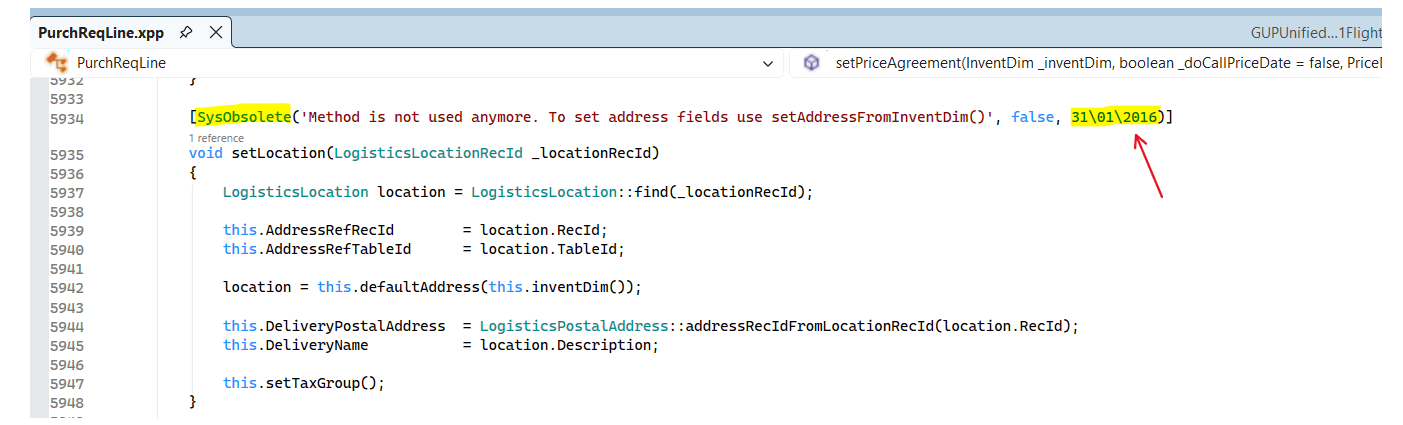
SysObsolete is an X++ attribute used to mark classes, methods, fields, or enums as deprecated. It signals to developers that an element should no longer be used and may be removed or replaced in a future release. When applied, the compiler emits warnings (or errors, depending on severity) whenever the obsolete element is referenced, guiding refactoring toward the recommended alternative. SysObsolete is a key mechanism for managing technical debt, ensuring forward compatibility, and enforcing controlled deprecation without breaking existing code immediately.

In the codebase, these attributes typically appear directly on the artifact itself, making their intent explicit at compile time.

I did a small count using Agent Ransack and found 3,994 methods marked as obsolete. I fully understand that Microsoft must account for customers, partners, and ISVs that still rely on parts of this surface area. That said, the cleanup process is objectively slow. We still have code that has been obsolete for more than a decade, which indicates a systemic issue rather than a temporary compatibility concern.

According to Microsoft documentation, obsolete methods may be deleted unless telemetry shows that they are still being used. If telemetry indicates usage, Microsoft will not remove them in order to reduce the risk of breaking consumers. This is an important detail: the presence of obsolete code is not the real problem — continued usage is. As long as deprecated APIs are still invoked in customer or partner solutions, Microsoft is effectively blocked from removing them.

Microsoft therefore recommends compiling your codebase against the latest application and platform versions at least every 12 months. Any warnings caused by deprecated or obsolete artifacts should be addressed as soon as possible. In practice, these warnings should not be treated as background noise. They are an explicit signal that technical debt is being carried forward.

This leads to an uncomfortable but necessary conclusion: a significant reason obsolete code remains in the platform is that customers, partners, and ISVs are not acting on compile warnings. If obsolete APIs continue to show up in telemetry, Microsoft cannot safely remove them — regardless of how old or redundant they are.

As a community, we should take more responsibility here. Cleaning up our own code and removing dependencies on obsolete APIs makes the platform healthier for everyone. When telemetry no longer shows usage, Microsoft can finally complete the deprecation cycle. This is one of the few areas where individual discipline directly enables platform progress.

The same reasoning applies to flights and feature flags. A quick scan shows 8,914 classes ending with *Flight, many of which are enabled by default today. Flights serve an important purpose during controlled rollouts and experimentation, but once a flight is globally enabled and has proven stable, it has effectively completed its lifecycle.

At that point, it should enter a formal deprecation path. Permanently enabled flights that remain in the execution path add:

  • Cognitive overhead for developers
  • Runtime condition checks
  • Upgrade and refactoring complexity

In many cases, they have simply become technical debt. While each individual check may be cheap, the cumulative cost across the platform is not zero. Every conditional branch executed thousands or millions of times per day matters.

The same applies to features that are now considered part of the core behavior. If something must remain configurable for business reasons, it should be expressed as a parameter, not as a flight or feature flag. Flights are a rollout mechanism — not a permanent configuration model.

None of this ignores the realities of backward compatibility or long customer upgrade cycles. Microsoft is right to be cautious. Telemetry-based decisions are safer than forced breaking changes. But that caution only works if the ecosystem does its part.

AI and Copilot will help us write more code. They will not reduce the long-term cost of carrying unnecessary code forever. D365 will be delivered, extended, and maintained for many years to come. If we want it to remain performant, understandable, and evolvable, we need to treat deprecation as a process that actually completes — not as a warning we learn to ignore.