At the inspirit365 Vision Summit in Paris, I got to present details from the latest Gartner report, Hype Cycle for Retail Technologies, 2023. There are 4 areas I would like to relate to the Dynamics 365 Commerce offerings, where I think Microsoft have a very strong offering. I cannot share the Gartner report, but I highly recommend you to seek it to get the full report.

I will try to link these 4 technologies towards what we have in Dynamics 365, and what Microsoft have in their short upcoming roadmap.
1. Retail Media Technology Platforms
The definition of this hype is technology platforms for retail that supports media networks. This allows stores to display products from third parties, such as brands, while the customer is shopping. Most often used online, it can also be used in physical stores for a comprehensive retail strategy. The upcoming Omni-channel media management features fit’s into this this hype.
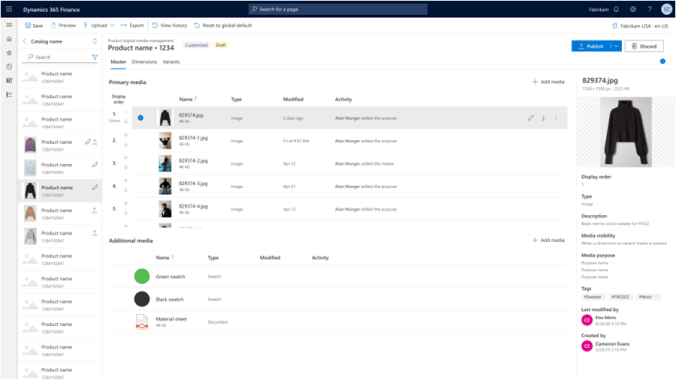
In the complex ecosystem of retail, efficiency and simplicity are paramount. Microsoft Dynamics 365 Commerce addresses this by offering native media management features that are seamlessly integrated between the Commerce headquarters and site builder. This integration streamlines the media asset management workflow by centralizing it in the Commerce headquarters, the very locus where merchandising decisions are made. This strategic enhancement reduces complexity and operational friction for both system integrators and merchandisers. By offering an omnichannel media management solution that is immediately functional ‘out-of-the-box’, Dynamics 365 Commerce substantially elevates the efficacy of retail operations. You can see the solution in action on YouTube.
2. Unified Commerce Platform
Dynamics 365 have been fortunate to be in this space for a long time. The definition of this hype is having a comprehensive trading platform simplifies commerce across all touchpoints, allowing customers to see, purchase, and engage. It connects stores, kiosks, websites, mobile, social media, and smart devices, regardless of how they are used. I cannot emphasize enough the importance of have a out-of-the-box architecture to support this. I know that more is wanted, but I also see ongoing investments like micro services for Inventory Visibility, and more coming. It may be a hype for Gartner, but for Dynamics 365 it is an reality.

3. Contextualized Real-Time Pricing
The definition of this hype is having real-time pricing based on attributes and relationships allows for immediate price adjustments across all touchpoints. Prices can be influenced by factors such as competitor pricing, special offers, customer loyalty, and immediate demand. This dynamic pricing model enables businesses to respond swiftly to market changes, optimizing revenue and enhancing customer satisfaction. It’s a modern approach that aligns perfectly with the imperatives of omnichannel retail.
The feature from Microsoft that supports this, is the Manage attribute-based omnichannel sales pricing. The full documentation is available here, but I wanted to show my interpretation of this solution. Prices are a sequence of steps, and triggers/attributes explaining when the different components should be active.

Attributes are properties that can be placed on not only customers and products, but also on more transactional properties like sales order header and line. When a price component is activated are the union of them.

As each component can be activated it means we can have a price tree, that controls the sequence and enablement of the components according to attributes. Microsoft uses the following diagram to show how different calculations approaches can be built.

Performing real time calculations are a compute intensive achievement, and if you have been in the field of combinatoric and permutation complexity we know that calculating the best and perfect price is difficult. And I know that this have a special focus at Microsoft. The solution is still in preview, and I expect that we will see performance improvements in the near future.
4. AI in retail
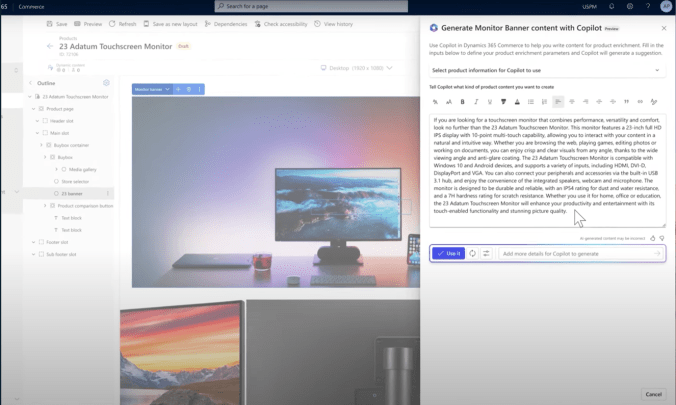
The definition of AI in commerce is about technology that adapts without specific programming, based on data and usage. These systems recognize patterns, predict events, and operate autonomously. AI is critical for algorithmic trading and is often a part of business applications provided by vendors. Indeed, the integration of AI capabilities can transform retail operations by automating complex tasks, offering predictive analytics, and personalizing the customer experience. In a marketplace increasingly driven by data, AI’s role in enabling intelligent decision-making is invaluable. The first step on this journey are Co-Pilots, that we gradually see is lighting up in the Dynamics 365 stack. Most merchandisers with large product catalogs want a more efficient way to enrich products, and one of the area I look forward to is the use of CoPilots to generate product enrichment content for e-commerce sites/sitebuilder. To see it in action, take a look at the following YouTube video.
Conclusion
The future of commerce is not a distant horizon; it’s unfolding right here, right now. The latest advancements captured in Gartner’s Hype Cycle for Retail Technologies, 2023, echo strikingly well with the functionalities and roadmaps of Microsoft’s Dynamics 365 Commerce. From leveraging omnipresent media platforms and unifying commerce across various touchpoints to real-time, attribute-based pricing, and the game-changing role of AI, Dynamics 365 is not merely keeping pace—it’s setting the pace. These aren’t just technological ‘hypes’; they are tangible solutions shaping the next chapter of retail. I invite you to not just read the report but to experience these innovations firsthand. Remember, we’re not talking about the future in abstract terms; with Dynamics 365 Commerce, the future is an executable file. Stay tuned for more insights, and as always, let’s continue to bridge the gap between technology and real-world retail solutions.
 Kurt Hatlevik - Dynamics 365 Blog