I’ve been implementing D365 since it first became available. Over the years, the improvements have been both incremental in the short term and fundamental in the long run. Cloud, AI, and modern architecture have reshaped what’s possible.
But what puzzles me is this: the costs of implementing D365 and transforming business operations haven’t changed in any dramatic way. In short—it’s still as expensive as before. D365 projects remain a significant investment. I haven’t seen groundbreaking cost reductions nor revolutionary improvements in project timelines.
Is it the complexity of the businesses we serve that keeps costs high?
Or is it the way we implement?
We now have more tools than ever before: preconfigured templates, industry accelerators, AI-assisted data migration, automated testing, low-code/no-code extensibility. But has any of this translated into faster, leaner projects? Or do these same tools just create space for more scope, more configuration, and more “what if we also…” discussions?
Maybe the real challenge isn’t the technology at all, but people. Business transformation has always been more about change management than software deployment. Even with better platforms, organizations still struggle to align processes, culture, and governance. Could these softer elements be the real bottleneck—and no technology ever deliver the cost reductions we expect?
Or is it us—the implementers?
Do we hold on to project models that worked in the past instead of fully embracing new approaches? Are we overcomplicating, or simply responding to inherent complexity?
And perhaps there’s another angle: the way projects are guided from the top. Do managers at implementation partners truly understand the realities of modern D365 projects? Or are decisions sometimes made with outdated assumptions about effort, scope, and methodology? It’s a delicate question—but if the leadership guiding these projects hasn’t evolved as quickly as the technology, could that also explain why costs remain stubbornly high?
And what about the customers?
Do they sometimes expect D365 to be a silver bullet, expanding scope beyond what’s realistic? Does the push for customization and perfection undermine the potential for a lean, standard-first approach?
If costs haven’t dropped, maybe the question shouldn’t stop at cost. Perhaps the value and revenues for companies implementing D365 have increased—making the same (or even higher) implementation spend worthwhile. Have organizations gained agility, sharper insights, or stronger customer engagement that offset the cost? If so, maybe the calculation has shifted from cost reduction to value creation. If not, then the cost question becomes even more urgent.
Looking back, I see remarkable progress in the platform itself. Yet when I look at implementation costs, I can’t shake the question: have we really moved forward in how we implement?
So the question remains: Have you actually seen D365 implementation costs go down—or is the real story in the value delivered?
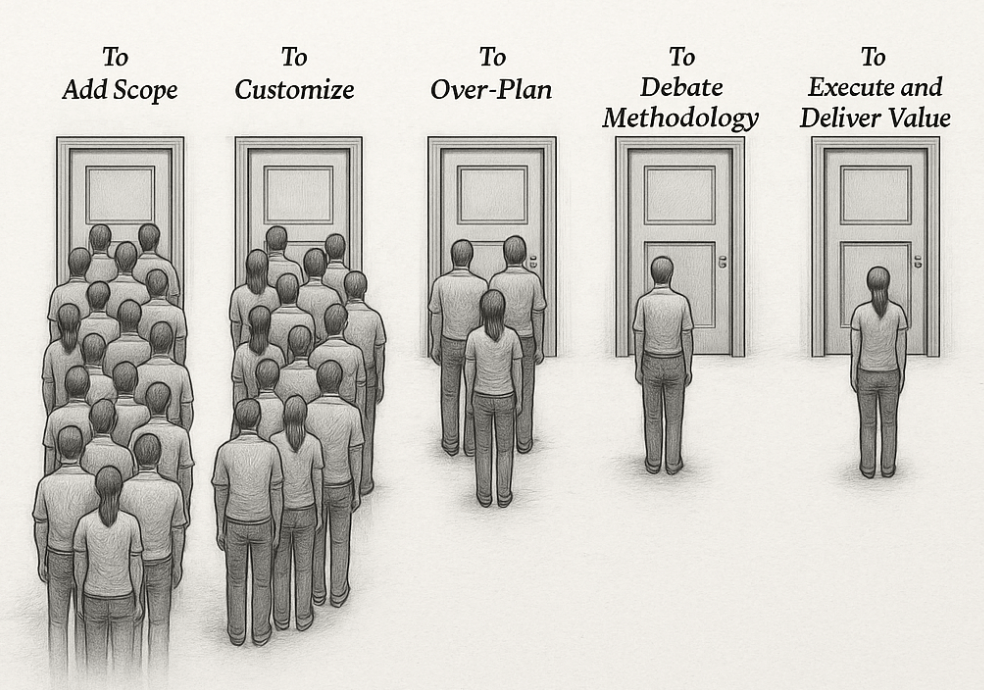
Some facts to reflect on
- Implementation still costs 2–5× license fees — $50K in licenses often means $150K–$250K first-year total (source).
- Timelines haven’t collapsed — large D365 projects still average around 14 months (source).
- Value is real — IDC found organizations gained an average of $20.6M in annual benefits after D365 implementations (source).
Chatty have helped with this post, but all content is mine.
 Kurt Hatlevik - Dynamics 365 Blog
Very interesting topic and good questions!
When D365 was still called AX7 (I am not sure I know how it is called now), we had to learn stuff. How to develop. How to manage the environments. Those are not really “project costs”, as they are not invoiced to the customer… but they were “partner costs”.
And the product has improved. The entities work better now than before. The POS works much better than in the early days. More functionality is included, less needs to be developed.
As of the timelines… it depends. We now implement a medium retailer (with simple processes) with kickoff in June and golive in November. In the early days of D365, we would not have been able to do it. But if we have the time… as you say, the customers today expect more and the scope grows.
The “more functionality” can mean “less development”, but it can also mean “whole new areas covered by D365 that were previously covered by 3rd party”. Like WMS. Or demand planning.
In general – I think we are more efficient now than before… rather thanks to product maturity and partner experience than the new tools. The new tools for us still carry the learning cost that offsets the savings… and will hopefully translate into total savings later.
LikeLike