Bad bosses do, “tight lines”

Bad managers are often weak on communication – with poor performance on employee relations. This must often be compensated with unnatural hierarchies and “tight lines”. One does not become a better leader by turning a deaf ear.

Leadership is about to listen, analyze signals and to make decisions – whether they are popular or not. But the definitive answer for leadership does not exist. Management is also situation-oriented. The leader must deal with a story, an environment, a culture, individuals, its place in the “life cycle”, the market and much more. Being a good leader, requires expertise in a wide variety of disciplines. Not least, psychology and sociology.

We see many thoughts, theories and concepts related to management. Dear child apparently has many names. No matter what we call field of management, the management is a balancing act that involves many audiences. One should relate to a board, to other management and employees. Yes, let’s call it for internal communications. But one should also relate to external audiences. Be could be customers, potential customers, parters, owners and shareholders, regulators, journalists, and more.

Being a leader is so that one must master many disciplines, one must be both broad and deep. And you have to continuous speeding up and braking down. It is a great achievement to be a good leader.

Modern management is not only about involvement. One must care about people to get them to perform. And the staff must be very much feel they are listened to. The leader must be real – those who only play a role is in fact quickly discovered – and then threw out the door.

I work in IT-industry, and we work in a tremendous pace. Then the leader must also show willingness to change with an equally high speed. If not – it’s over and out.

Among the requirements is that the leader must be involved and receptive – and make their decisions based on a totality of ideas, arguments and values. Then it is important to listen to his subordinates, involving them in decisions and the courage to put the hierarchy aside for the best ideas.

It is also true that the strongest communities often employ the brightest minds. These are people with a commitment and that largely wants to have influence on their everyday life and its development. Modern leaders also attracts the best resources. They both courage and ability to hire the best people. The receptive and dynamic leader will both develop the company, employees and themselves. I believe it is this that gives companies and organizations progress and success.

The smartest leaders treat the employees as enthusiastic, intelligent and independent people. They are involved and they are strong enough to take decisions based on good processes.

Good management requires insight into the people and the courage to get involved, and that is what I feel I’m experiencing as Columbus IT Norway consultant. If you have a bright mind on ERP and Dynamics AX and to want to experience true leadership I encourage you to contact us.

Slotting ROI: Tangibles and intangibles

This is a brief rundown of possible benefits of slotting and its impact on several operational factors, from different sources and our own experience.
Some warehouses with few SKUs and trivial order lists may not need slotting at all. The larger and more complex a warehouse becomes, the more slotting will have an impact. Ranges of % in benefits are for typical warehouses, but can vary from 0% – to even more than what is stated. Values are extremely dependent on several interacting aspects of warehousing, most significantly: order profiles, diversity of SKUs, geometry of warehouse, the existing layout and slotting procedure.

Pre-Slotting

Layout:
For warehouses using many different products, mixing several storage systems becomes more cost-effective than using only one type of storage. However, rule-of-thumb systems are difficult to size and results can be far from the optimized solution, with productivity impacts up to 30-40% on replenishments and picking.
The optimal balance between types of racking can be determined using specialized software, evaluating the relative needs for replenishment, picking rates, space, flow-rack cost, etc.

Space Maximization:
Pre-slotting determines the optimal quantities and storage types for products based on their order profiles. This maximizes the warehouse cube, thereby cutting the square footage requirements with possible space savings in the 35% – 43% range.

References:
– Bartholdi and Hackman, Warehouse & Distribution Science 2010
– Avery, Operations and Fulfillment, July 1999

Dynamic Slotting

Typically, static slotting for distance and velocity alone can reduce labor cost by 10%. Further savings of 5% can be achieved by using batch picking and product family grouping. Dynamic slotting uses floating-pick storage spaces, and uses specific-period strategies instead of product life-cycle strategies. Receiving and put-away are directed moves to specific locations. This results in sustained productivity, with measurable savings in operational costs from fixed slotting.

Space Utilization:  minimize allocated free space because of adjustable assigned volumes.

Put-Away: Directed put-away reduces guesswork and eliminate errors, and removes the need to search the warehouse for locations.

Replenishment: Synchronizing stock replenishment and space allocation can significantly reduce the number of stockouts, a time-consuming problem for high-throughput distribution centers. A case study showed results of up to 77% less stockouts.

Picking Efficiency:
Results indicate that order fulfillment time can be reduced by 20%. Using an optimal combination of picking policy (good slotting may optimize batch picking strategy); up to 50% in labor savings from traditional strategies can be reached.

Order completion and shipping: reduce management and order completion time, as picking is optimized.

Some Intangibles:
Many aspects of warehouse operations will experience reduced pressure because of smart slotting:
– put-away management
– order picking management
– shipping management
– improvements in key metrics (KPIs): picks per hour, cycle times, inventory turns, order accuracy, order checking.
– enhanced work environment and safety (ex.: high velocity items in safe locations)
– fewer material damages (less distance traveled, less material relocation and handling)
– equipment wear

References:
[Petersen CG, Aase G, Int. J. of Production Economics, 2004]
[Launders, IIE Transactions, August 1996]  37% improvement cited
[Frazelle, 1990] 20-50% improvement in picking time.
[X.He , SP Sethi , J Optim. Appl. 2008ç
[Gagliardi, Ruiz, Renaud, 2008] 77% stockouts

Conclusion:

Slotting has an impact on all of warehouse operations and KPIs: productivity, shipping, inventory, stocking, order cycle, storage. The typical distribution of cost in warehouse operations is [Frazelle, 2002]:
–    Order Picking: 50%
–    Shipping: 15%
–    Receiving: 15%
–    Storage: 20%
Adding the savings from all operations, it is a reasonable assumption that dynamic slotting will provide 10 to 30% cost reduction from a baseline operation.

Studies suggest that in a typical warehouse, less than 15% of SKUs are properly slotted. Once fully slotted, most warehouses would save 10 to 30% on operations. For a medium size distribution center with several thousands of SKUs, simulations also show 20% savings in total labor cost. Examples of 100% improvement in both productivity and response time have been reported. Given that planning cost and establishing a slotting strategy is minimal in capital investment and risk, this is a most profitable ROI.

Possible improvement on Warehouse KPIs:
–    Picking rate: 20-50%
–    Order completion time: 25%
–    Storage efficiency: 0-30%
–    Equipment usage cost: 25%
–    Material damage: 25%
–    Space utilization: 5-40%

Tips on improving Warehouse Operations

Some of the most costly processes in the warehouse are picking and pack out process. They also account for the majority of the warehouse operational time- Lets discuss some of the key aspects that should be considered to reduce cost and increase warehouse operations efficiency.

Location planning

    Deciding the location for placing the item plays a key role in increasing the handling efficiency. Following factors should be considered while assigning a location for a particular item, number of counts of the item, Item’s volume and weight, sales volume during normal and peak periods of warehouse operations, special handling requirements and if any value added services like kitting etc is required to be done.
    Typically products are slotted in the storage mediums like pallet racks, drive in or drive through racks and bins. Once location is designated the next thing would be the numbering and grouping of the locations. Numbering should be done based on the building, zone, level bay facing and aisle. This activity will help in increasing the picking efficiency and reduce the time spent by the pickers searching for products.

Classification

Item’s should be grouped intelligently like fast movers, slow movers and medium movers. One should place the fast moving item’s in the locations which are closest and easier to reach and in a place close to the order fulfillment stations, this will improve the time taken to fulfill an order. Similarly slow movers can be placed in remote slots inside the warehouse as it will not be affecting the average picking time since these are sparingly ordered.

Refill

Internal routines must be developed to replenish the fast moving items in the line locations this will help in reducing the time taken to pick as the pickers will not be going back with zero inventories in the designated locations. Warehouse operations can decide the basis for refill like need based or minimum stock level refill’s which will reduce the labor cost in doing refills.

Storage types

Couple of broader classifications available for storage of products is flow storage and static storage. This contributes a lot in improving the bottom line and reducing the time and labor for doing picking and replenishment’s. The main advantage of flow storage is that the products will be coming to the pickers and they don’t have to go in search of item’s. With the help of modern control systems any warehouses using the conveyors and carousels to bring the products to the place of order fulfillment stations will be able to show a much higher productivity. The capital expenditure done to accomplish this will make a lot of difference in the bottom line of warehouses. This one time expense can be justified if the warehouse experiences a lot of activity and involves a lot of labor for picking and packing.

Source : http://www.infosysblogs.com

KPI’s for a warehouse customer.

At a customer we have implemented a role center, so that all resources can see company the KPI’s for maximizing the throughput.  I wanted to share with you the KPI’s and the results achieved.
We decided to focus on 4 roles, with up to 6 KPI’s per role.  We also decided to have 6 KPI’s for role.  Here is what we implemented :

Customer service :
– Open sales orders : Total number of open sales orders
– Open orders where customer is stopped :  Worklist to get in payments from past due customers.
– Delivered not invoiced sales orders : Worklist to make sure as much as possible is invoiced as soon as possible.
– Reserved ordered sales orders : sales orders that depend on a purchase or a production.
– Delayed sales orders in relation to confirmed date: Worklist for setting focus on delivery time

Purchase :
– Not sent purchase orders : Worklist of purchases that has been created, but not sent to the vendor
– Open purchase orders : Just a total
– Not confirmed purchase orders – Worklist to get confirmation dates from the vendors
– Received but not invoiced – Worklist to pay vendors
– Received today
– Planned purchases : How many purchase order lines have the master planning recommended that is firmed today.

Order processing
– Invoiced today (# and sum) : A KPI to make awareness of that invoicing is the final measurement of the company, and critical important that this goes smoothly.
– Invoiced yesterday (# and sum) : KPI to measure if we are better than yesterday .
– Packingslips today : How many packing slip updates have been done sofar today
– Ready for picking : How many picking routes are complete reserved and can be printed and picked
– Picking Now : How many picking routes are currently being picked ?
– Picked sales orders : Hos many picking routes are completed, and awaiting packing ?

Production
– Productions ready for picking : Number of productions, where all BOM-items have been physically reserved, and just waiting for picking the BOM-items.
– Ended productions today : How many productions has been completed so far today
– Started productions : How many productions is currently started ?
– Delayed productions – How many productions are delayed according to the production finishdate(Delivery date)
– Planned productions : How many productions should be created from master planning today.

Since much of the order processing is automated, and sales picking routes are released automatically, the workforce can focus on the KPI that leads to that the system can generate as many picking routes as possible.  Then the workforce is focused on the physical work, and focus is always to maximize the productivity.
The result is a reduction of internal lead time with 2 days, No more add-hoc overtime, and a much more focused workforce.  Visibility is the key to success.

To-Increase Warehouse Management and Distribution R2 is ready for release

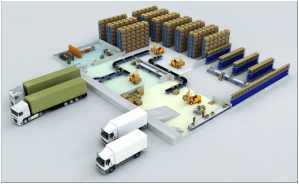
It has been a long time since I last had the chance to write about the WM&D.  But now a major release is ready.  The last months there has been a lot of implementations, and it is greate to see the positive response we get from the customers.  The WM&D is now setting focus on adding WMS and distribution value to the new Dynamics AX for retail, that Microsoft is launching in august.   
 

2. What’s new?

2.2.1 Standard, professional, and enterprise editions.

To support different distribution scenario, the WM&D is now offered in 3 different editions.

Standard edition – is a value offer to small to medium enterprises, and focuses on the traditional processes like receive, picking packing and shipping.

Professional edition – is used for every day distribution centers, and is extended with support of cross-docking, license plates, kitting and VAS.

Enterprise edition – is multi site distribution centers that often have yard management, mini load, conveyor systems, transportation planning and EDI integrations for both inbound and outbound.

More details of the different editions is available on the To-Increase partner portal, or contact your Partner Account manager.

2.2.2 Full support for WMS processes

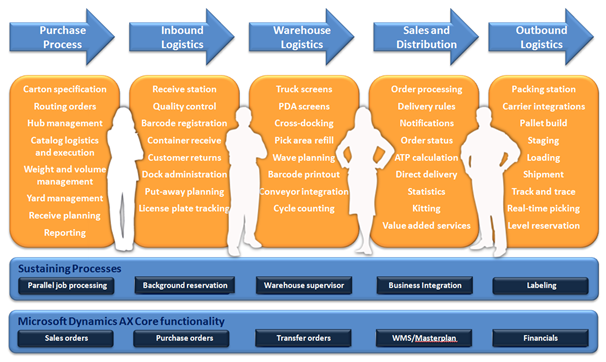
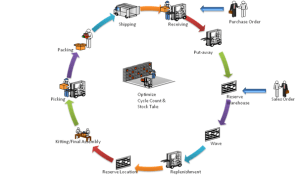
The main theme for the R2 has been to give users of WM&D a full featured WMS system. The basic processes can be visualized like this. With the introduction of Kitting and VAS, the full circle is complete.
2.2.3 Additional Language support

In the R2 release the WM&D has been extended with Danish language, and WM&D is now supported with all English, Norwegian and Danish. In addition Spanish demo language has been created. Other languages will be available on request.

2.3 Purchase process enhancements

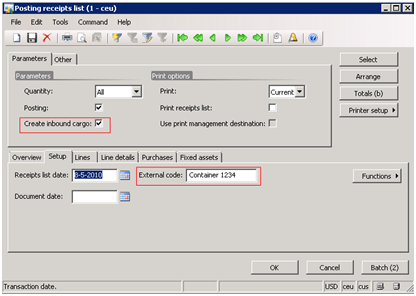
2.3.1 Create inbound cargo from receiptlist/ASN

To better support the use of inbound cargos, the receipt list posting, has been extended so inbound cargo’s can be created when manually posting a receipt list. In R1, this process was only supported when the Advanced shipping notification (ASN) was received through AIF/BizTalk.
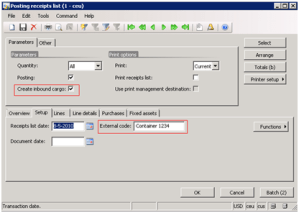
This makes it easier following up inbound for companies that have not a full EDI integration to vendors and carriers. This feature is now available in the professional edition.

2.4 Inbound logistics enhancements

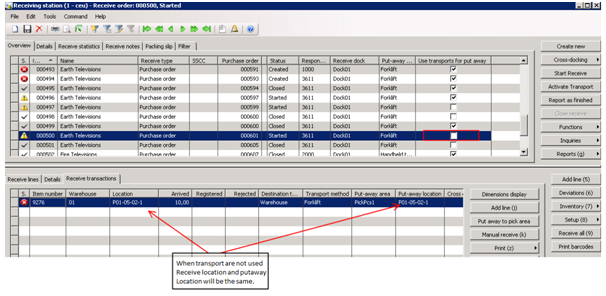
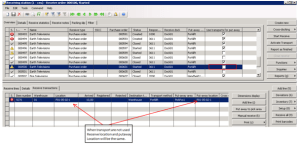
2.4.1 Support put away suggestion for receipts without pallet/location

Receive station has been extended to support a better suggestion for locations, when internal transport are not used. The receive station will now search for locations first in buffer area, and then in the pick area. This simplifies the use of receive stations in scenarios where PDA/RF devices are not in use.
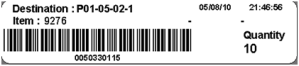
2.4.2 Support put away labels

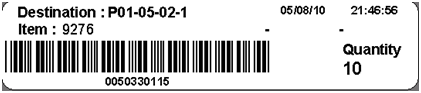
From the receive station it is now possible to print put away labels that can be scanned by PDA.
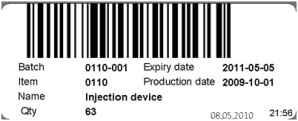
2.4.3 Support batch labels

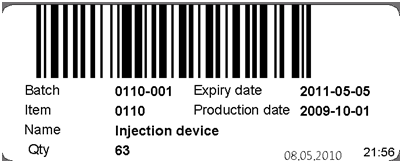
From the receive station it is now possible to print batch labels that can be scanned by PDA in later process
2.5 Warehouse logistics enhancements

2.5.1 Improved outbound processes

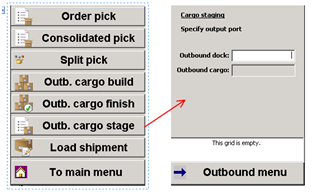
With WM&D R2 the Pick->Pack->Stage->Load->Ship process has been improved, and additional screens for staging has been introduced.

2.5.2 Manual wave processing

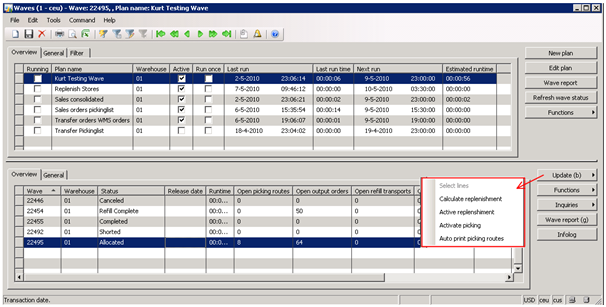
In R1, the creation of waves was very automated. A new wave overview has been created to give better insight and steps involved in a wave planning scenario.
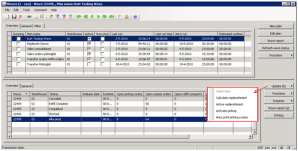
Users can now manually select, calculate replenishment, activate replenishment, activate picking, and print/release picking list for each wave.

Functions for wave merge and wave shortening has been introduced.

2.6 Sales and distribution enhancements

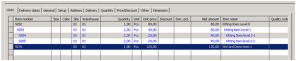
2.6.1 Kitting

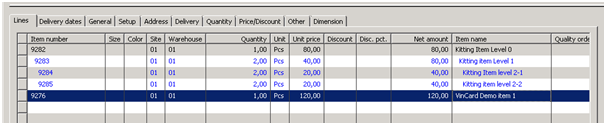
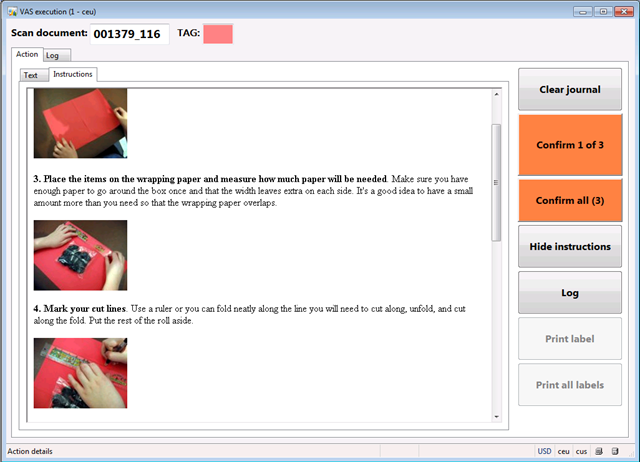
Kitting offers companies that are not equipped with finished goods warehouse facilities or cannot afford the capital expenditure of setting up a finished goods warehousing facility. Your company can take advantage of the services that are necessary to forward a product to market quickly. Kitting involves the assembly of products in boxes, shrink-wrap, blister, or clamshell packaging.

Some companies require assistance preparing their product for shipment and display. There is a better chance of selling your product if it is accurately packaged and prepared for market. There is nothing worse than excitedly opening a new item just to find that pieces are missing from the package.

Just an example of how this process may work: You have several items that belong together in a package. In an assembly line, each individual in the line subsequently adds another component to the package in a specific order. This ensures that everything is included in the package. At the end of the assembly line, an individual conducts a quality review. Part of that review could include weighing the package. If the weight of the package is accurate, then all the parts have been included; no more no less. If the weight is incorrect even by a couple of ounces, then it means that either a component is missing or there is an additional part.

Kitting allows the warehouse to build an order for shipping then distribute or store it. Getting the distribution center to kit your products not only prepares the items for distribution, but may also save your company money, because you do not have the labor costs and capital expenditures to deal with.
2.6.2 Real time wave processing

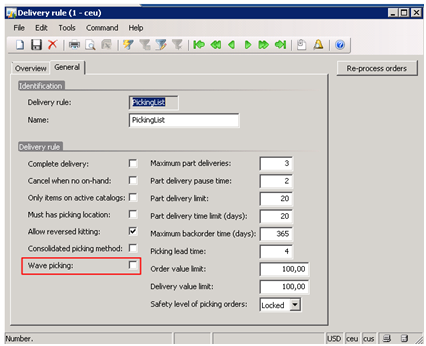
In R2, a real time wave processing is available. As soon as an order is confirmed, the order processor can automatically release replenishments and activate picking lists. This is well suited for same-day delivery scenarios.
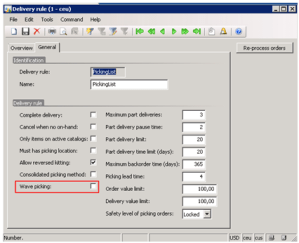
By removing the “wave-picking” check box, the system will do real time order processing and replenishment.

2.7 Outbound logistics enhancements

2.7.1 Batch picking

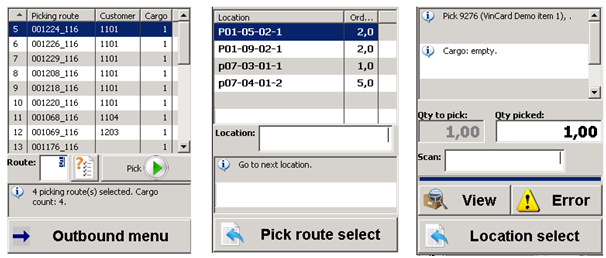
Batch picking is a process where multiple orders are picked simultaneously, and it is used to reduce transit time. With a “man to goods” system where an order selector travels to the product to fill orders, batch picking can drastically reduce the travel time. In a “goods to man” system where product is delivered to the selector, batch picking can reduce delivery traffic.
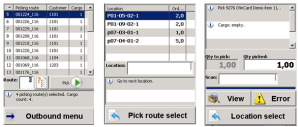
Batch picking is only available when using handheld PDA’s

2.7.2 Zone picking

Zone picking has been introduces, so that WM&D creates one picking route per pick area.

2.7.3 Value added services (VAS)

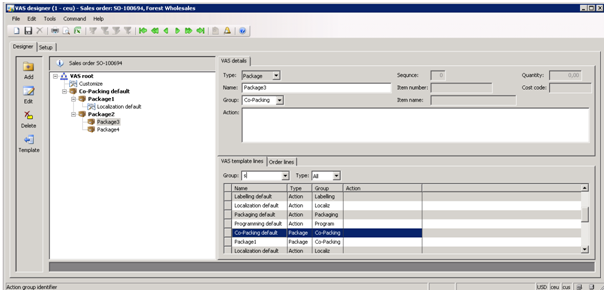
A new value added service solution has been created to support VAS functionality. We define VAS as a set of actions, associated costs, expenses and additional items that we want to be logically bundled in order to be easily and logically presented to a stakeholder (a sales processor, warehouse worker or end customer).
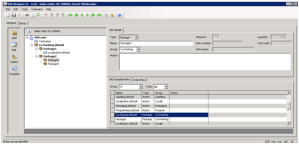
VAS is an atomic item, having a specific VAS type that can be

a) Item. An item that exist in the sales order.

b) Cost. A cost associated with VAS, which corresponds to a misc charge on the sales order. There will be also a functionality relating a cost code that is an attribute of VAS line, to a set of misc charges that will automatically be added to the sales order whenever VAS line of type Cost is included.

c) Service. A service that is associated with a service sales line.

d) Action – a set of instructions to a warehouse worker with the guide of what and how to do in relation to the VAS.

e) Package. Used to specify that some set of items needs to be packed together.

f) Labeling

A VAS designer let’s you define the VAS services that must be applied to a salesorder.

The effect of this is the VAS execution that confirms every VAS step needed.
Warehouse Management and Distribution for Dynamics AX 2009

Finally, the product is being announced publicly. At the convergence 2008 in Copenhagen. If you visit the Columbus and the To-Increase Booth you can have a live demo and a try of the new WMS product. The last months I have done many demo’s and the feedback is very good. We have also used the last months to quality check, test and prepare the product for general availability. The first customer will be going live on the product on the 2/1/2009. We are aiming for a slow start of new customer, and will not accept more than 5-10 customers in the first phase of the rollout. This to ensure that we have the time to give god partner- and customer training, and to further improve product quality.

Here is a quick overview of the functionality:

More professional factsheets are on the way, but I can give you some sneak preview of the texts:

Warehouse Management and Distribution for Microsoft Dynamics AX

Maximize operational efficiencies, reduce labor costs, and drive proactive logistics planning for warehouse and distribution processes.

To-Increase Warehouse Management and Distribution automates the materials handling process for retailers, manufacturers, distributors, and third-party logistics providers. By integrating advanced radio-frequency (RF) and bar-coding technologies with core warehouse automation, Warehouse Management and Distribution streamlines order management, receiving, stocking, replenishment, picking, and shipping. Your organization can move forward to enhance customer satisfaction with faster turnaround times and precise order fulfillment.

Increase productivity from the start. Deliver a solution that people can learn and use in minutes, on multiple devices. Designed to minimize training time and costs, Warehouse Management and Distribution offers simplified user screens that give your staff the precise information and tools they need to perform tasks quickly and accurately.

Improve efficiency and accuracy to reduce costs and drive customer satisfaction. Automated processes, real-time information flows, and graphical planning tools ensure fast, error-free inventory tracking, picking and packing processes, and order fulfillment. Integrated warehouse robotics and conveyor systems help minimize labor costs and drive faster turnaround time, while still ensuring that goods are delivered to the right location.

Drive speed and quality control across your entire supply chain. Warehouse Management and Distribution offers direct integration with inbound and outbound freight provider systems. You can quickly send purchase orders electronically to both vendors and freight forwarders, receive advanced shipping notices (ASN) from vendors and freight forwarders, and trace all outbound packages in real time. Automated alerts ensure that the right people within your supply chain know when issues arise. Equipped with access to complete, real-time information, your staff, your vendors, and your partners can quickly resolve issues and keep processes running smoothly.

Accelerate performance now and accommodate future growth. Warehouse Management and Distribution is designed for today’s fast, high-volume transaction environments. The solution builds on robust, integrated Microsoft Dynamics® AX capabilities to deliver an end-to-end warehouse management solution.

Seamlessly connect warehouse operations

By taking advantage of RF-based barcoding technologies and seamless integration with order management, Warehouse Management and Distribution tightly orchestrates picking and packing within your warehouse, maximizes staff productivity, and facilitates quick order fulfillment.

  • Support efficient process management for a range of picking styles, including wave, batch, simultaneous, or sequential zone.
  • Give operators the agility to execute picking and packing tasks using only touch screens and barcode scanners.
  • Increase order accuracy and eliminate errors related to paper-based procedures. All picking lists can be picked directly from PDA or forklift screens.
  • Fill multiple orders simultaneously and track inventory in real-time. Minimize your picking area and use wave planning to move only items that are needed to complete an order.
  • Gain a complete view of all warehouse activities through the role-based Warehouse Supervisor screen.

Simplify and streamline receiving and shipping

Rich capabilities for shipping, receiving, and put-away processes ensure efficient transfer and movement of goods—whether they’re inbound, in transit, going from your receiving dock to the warehouse, or outbound.

  • Speed up receiving processes with barcode scanning of cartons and automatic volume and weight registrations.
  • Create Gantt charts that offer accurate overviews, schedules, and critical details for planning and receiving processes.
  • Cross-dock goods directly to outbound docks.
  • Produce shipping labels, packing slips, carton content labels, and advanced shipping notices on demand, eliminating transcription errors from customer orders.
  • Maintain complete status records, including images, to monitor quality control issues. Automated, real-time updates to sales and purchase orders ensure information flows seamlessly across the supply chain.

FEATURES

Vendor and freight integration

  • Ensure tight integration with inbound and outbound freight providers.
  • Send purchase orders electronically to both vendors and freight forwarders.
  • Receive advanced shipping notices (ASN) from vendors and freight forwarders.
  • Trace all outbound packages in real time via your freight forwarders’ systems.

External logistics and yard management

  • Easily create order routings for inbound goods.
  • Track all inbound containers and trucks.
  • Align planning for the receiving sequence with actual requirements.
  • Create Gantt schedules for inbound ports.
  • Easily track "customs clear" dates.

Receiving execution

  • Receive complete ANS, containers, and purchase orders/lines.
  • Automate the receiving process using barcodes.
  • Create license plates for every carton.
  • Plan the put-away process.
  • Enable internal and external cross docking.
  • Streamline receiving with Express Receive functionality.

Reverse logistics

  • Simplify customer returns with wizard-driven processes.
  • Create Returns Management Authorizations (RMAs) and business rules for returned goods.

Quality control

  • Maintain status records for quality-control issues, including images.
  • Include your vendors and business partners in the quality chain.
  • Send e-mail alerts to employees, vendors, or partners when quality issues arise.

Vendor statistics

  • Measure vendor delivery performance.
  • Use vendor statistics in negotiation processes.
  • Establish best practices for standardizing packing materials.

Delivery execution

  • Keep order management informed with automatic updates to sales and purchase orders, and provide graphical views of Available to Promise (ATP).
  • Use store/transfer orders to ship goods to stores.
  • Automate the reservation process.
  • Improve efficiency for packing processes by using packing stations.
  • Maintain performance statistics for picking processes.
  • Simplify shipping procedures with easy-to-use screens and functions.

Movement execution

  • Separate buffer and picking locations.
  • Use wave planning to refill picking locations.
  • Release fulfillment orders according to plan.
  • Access real-time picking lists from PDA and forklift screens.
  • Create seasonal/campaign location plans for optimizing the picking process.

Warehouse Management and Distribution engine

  • Optimize inventory allocation with intelligent soft and hard reservation functionality.
  • Real-time cost calculation eliminates time-consuming inventory closing.
  • Scale to manage high-volume transaction environments.
  • Quickly reconcile inventory values with financials to optimize inventory analysis.

License plate tracing

  • Enable warehouse workers to focus on cartons, pallets, and barcodes rather than item, sizes, and quantity.
  • Uniquely identify every carton.

Serialized inventory

  • Improve accuracy by serializing valuable items.

Barcode-enabled

  • Speed transaction processes with barcode scanners and touch-sensitive screens.
  • Items scanned using barcodes are automatically recorded in the ERP system, increasing accuracy and minimizing manual effort.

Easy label designer

  • Design and print your own labels with support for more than 2000 barcode printers.
  • Archive labels for reprinting.

Telnet and WinPDA for handheld operations

  • Support more than 50 warehouse processes using handheld devices.
  • Create additional PDA programs with an easy-to-use design tool.
  • Streamline resource allocation with automated release of work tasks.

Customizable e-mail delivery confirmations

  • Send automated delivery confirmations to customers.
  • Create standardized e-mail templates with an easy-to-use design tool.

Delivery rules

  • Create your own delivery rules for part delivery, minimum order values, and automatic cancellation of sales orders.
  • Automatically print/release your picking lists.

Automatic BOM explosion

  • Combine items into cartons that contain a mix of sizes and colors.

Conveyor integration

  • Move goods to the right destination using conveyor systems.
  • Support multiple conveyor systems with a single integration.

Transit locations

  • Easily monitor physical storage of goods.
  • Sell goods in transit, while still maintaining accurate inventory records.
  • Maintain inventory values for in-transit goods in financial records.

Microsoft BizTalk Server®

  • Standardize and centralize data and system integrations.
  • Map data across a wide range of message formats using file conversion capabilities.

TI-Wireless

  • Use Telnet devices to receive, transfer, count, pick, and ship items.

TI-RCM

  • Connect Warehouse Management and Distribution with Retail Chain Manager capabilities.

Workflow

  • Create workflows tailored to your specific needs.

Microsoft Dynamics AX Role Center

  • Work within the Microsoft Dynamics AX 2009 Role Center to report KPIs, statistics, and performance.

E&E WMS a new vertical solution is born

My current project is to specify a new large vertical for high end distribution enterprises. This is typical companies that have a high volume of transactions, have a set of own stores and also deliveries to consumer customers. As the design and development goes forward, I will try to give an insight of how we are working and what we are doing. Also try to give some ideas of the functionality in the solution. We have delivered many solutions for WMS handling in Columbus, and it’s now time to combine all the god solutions into one major solution. We already have customers waiting for this module, so

The WMS E&E is divided into sub-modules and this document is focusing in the inbound logistics.

01. Shipping Hubs and Yard management

E&E-WMS Shipping Hubs and YARD Management must give visibility beyond the four walls of the warehouse by providing yard and dock door management capabilities. This solution must handle all the shipping and receiving requirements by creating plans and managing inventory in the yard. Yard Management schedules appointments and tracks container and trailer position and status. It tracks task completion information so you can perform inquiries, run reports and review real-time information. Your carriers and suppliers can also self-schedule appointments or requests through electronic data interchange (ASN EDI 856 )—allowing you to turn loads more quickly and efficiently. At the dock door, Yard Management manages the timely arrival of loads and ensures that trailers unload at the right dock door at the right time. Through guard check-in and check-out procedures, you benefit from the efficient scheduling and management of appointments to reduce load and unload wait times—and reduce the risk of violating Hours of Service regulations.

Yard Management

  • Manages goods in the yard in real time through a graphical display
  • Plans and executes loads
  • Track and manage arriving containers
  • Allows carrier self-scheduling via electronic data interchange (EDI) , or manually planning according to ASN (Advanced Shipment Notice)(Subject to change or future implementation)
  • Increases visibility into inbound and outbound loads
  • Provides guard check-in and check-out functionality to maintain security and reduce unnecessary wait times.
  • Route purchase orders to be delivered to a active shipping hub at the selected date.


02. Receiving station

The Receiving system in this solution is divided into 3 handling systems, to support different receive strategies.

  • Container receive
  • Purchase receive
  • Purchaseline receive (Future)


The Dynamics AX Receiving Station is based on handling both containers and purchase orders. The receiving process can be done with both on screen (touch-screens), RF and paper. The Dynamics AX Receiving Station is also handling quality control on items and the labeling of serial/batch, items, cartons and pallets. The receiving module is also supporting integration to conveyor systems and automatic labeling systems. The receiving module can import carton weights and dimension from the integration. Each carton can be identified with a license plate, and be automatically labeled. The receiving also support a simplified external pallet warehouse. This can be used, when the warehouse capacity has been extended, and there is a need to utilize external warehouses. The system will allow for external receiving, and the system will also order pallet shipments from external warehouse to the main warehouses. The receiving module is directly integrated to the master planning, to secure the available to promise. The received items can also be placed under quarantine for customs and quality reasons.

This type of receiving is typically possible when there is a close relation between the shipment and the contents of the shipment. The receive system can then be set up for a more automated receive. The shipment consists mainly of similar cartons, and the receive if done by scanning EAN-barcodes. Typical industries are retail warehouses and distribution centers. Volume is high, and quality-control is done upfront or is limited. Item value is low.

03. Quality controll, recording

The quality control system is a comprehensive set of solutions, that allows the user to record, take action and report any issues related to product quality. The quality control system is linked into the entire supply chain, and can record deviations in purchase, receive, logistics and from sales.

04. Customer returns

The solution of customer returns is the process of handling both the logistical and financial aspect of returns. The items return must go through a cartonization process.

05. BarCode printing and Scanning

Most of the functional requirements regarding barcode scanning are integrated into the different modules as a way of input to the system. But for printing there will be built a separate module for handling labels. The main system for designing and printing labels is the BarTender system.( http://www.seagullscientific.com )

For labeling system there must be built a common system for producing labels. All labels generated in the system must go through this structure for being printed. The advanced structure is created for supporting different printer types in an enterprise. This structure will enable a system for extending several printers as the demand arises. Also a data structure for archiving printed labels is needed. Often the processes for creating the data related to labels can be time-consuming, and often the timeframe for printing a label is very small. A label archive will also enable the possibility to reprint labels if needed.

Dynamics AX Enterprice and cross-company queries

One of the things I’m missing in the Dynamics Ax, is the ability to do advanced cross-company queries. Many of my customers are international and they like to do reporting across companies. I was at the convergence 2007, and had the chance to talk to some of the developers regarding this. They are currently developing a "Site"-possibility in the inventory dimensions, but this is not the same. My suggestion is to extend the "Common-Table" with a new field called "Site", and then you actually could have different datasets per site. You could then enable to have different parameters on items, prices etc per site. I suggested this to Microsoft, but the change was too big to be supported in the current upgrade schema. The other thing, that would be useful, is a cross-company/site query. To extend the query object to fetch data from several companies simultaneous. A lot of modification have been made to do this, and to implement this in the core would really help.


/kurt